Currently
Looking for Spring/Summer 2027 Internships and Full-time roles
exploring mechanistic interpretability from a weight-space perspective
open to research collaborations
about.sh
$ cat bio.txt
Hello there!! I’m a CS PhD student at Boston University, trying to understand how multimodal models represent the world and where that understanding quietly falls short. I care a lot about who these models end up working for, so I put a strong emphasis on under-resourced communities, and a good chunk of my open-source tools and datasets come from that — see the projects and a partial list of publications.
Outside the lab you’ll find me with my plants🪴, my pottery ⚱️, or deep in pop-culture 🖖 (some of it lives here ✨). If any of the above sounds like something we should work on together, shoot me an email, or just say hi~
Group IVC-ML, Boston University
Advisors Dr. Deepti Ghadiyaram, Dr. Bryan Plummer
Research multimodal learning · evaluation · interpretability · efficient adaptation
Methods post-training · PEFT · latent probing · safety & alignment
Graduating Fall 2027 (expected)
Published in ICLR'25 · CVPR'26 · ECCV'26 · EMNLP'26 Findings · AACL-IJCNLP'25 · NeurIPS-W'24 · Interspeech'23


$ whoami
PhD Student, Researcher
📮 nimzia [at] bu [dot] edu
BUCDS, Boston, MA, USA
news
news.log
| Oct 23, 2026 | Officially a PhD candidate at Boston University! |
| Sep 02, 2026 | Helping teach CS 440: Intro to AI at Boston University as a Teaching Fellow |
| Aug 26, 2026 | Started internship at Adobe, San Jose, CA |
| Aug 21, 2026 | A paper I co-supervised has been accepted at EMNLP'26 (Findings)! |
| Jul 23, 2026 | Third first-author paper accepted at ECCV'26 (Main Track)! |
selected publications
publications.log
-
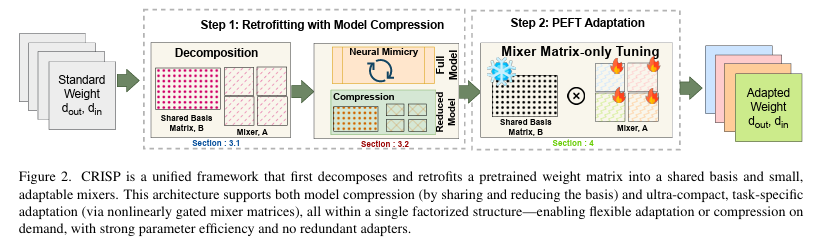 Decompose, Mix, Adapt: A Unified Framework for Parameter-Efficient Neural Network Recombination and CompressionParameter Recombination (PR) methods aim to efficiently compose the weights of a neural network, and encompasses tasks like Parameter-Efficient FineTuning (PEFT) and Model Compression (MC), among others. Most methods typically focus on one application of PR, which can make composing them challenging. For example, when deploying a large model you may wish to compress the model and also quickly adapt to new settings. However, PEFT methods often can still contain millions of parameters. This may be small compared to the original model size, but can be problematic in resource constrained deployments like edge devices, where they take a larger portion of the compressed model’s parameters. To address this, we present Coefficient-gated weight Recombination by Interpolated Shared basis Projections (\method), a general approach that can address multiple PR tasks within the same framework, which can enable seamless integration. It accomplishes this by using a factorization process that decomposes pretrained weights into basis matrices and their component projections. Sharing these basis matrices across layers and adjusting its size enables us to perform MC, whereas the small size of the projection weights (fewer than 200 in some experiments) enables \method support PEFT. Experiments on ViT models show \method outperforms methods from prior work capable of dual-task applications by 4-5% while also outperforming the state-of-the-art in PEFT by 1.5% and PEFT+MC combinations by almost 1%.
 -
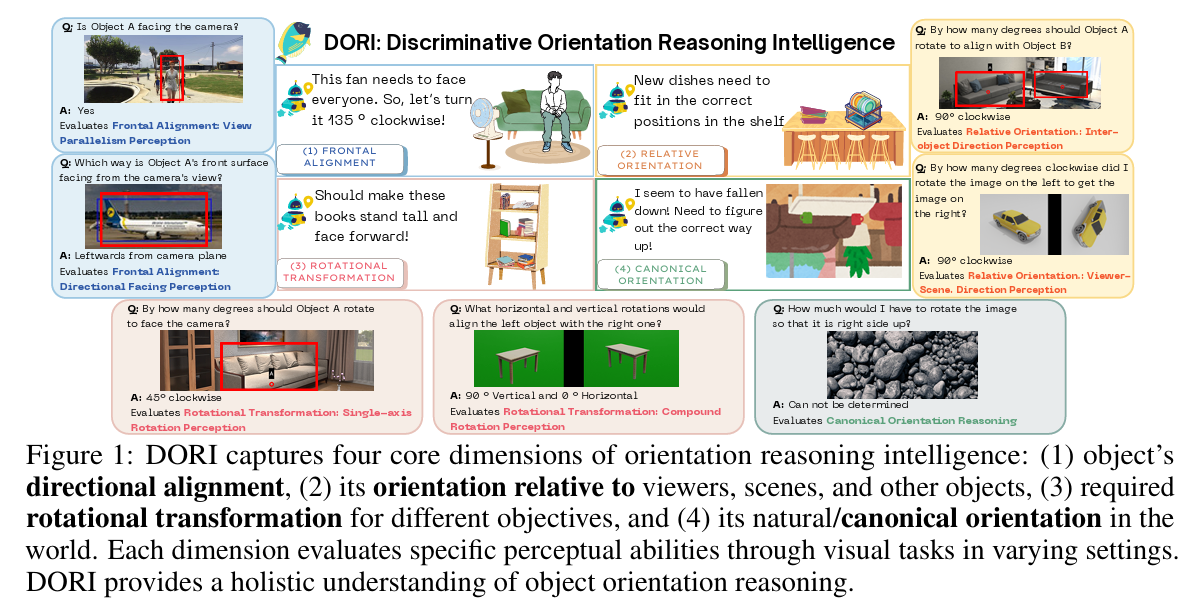 Seeing Isn’t Orienting: A Cognitively Grounded Hierarchical Benchmark for Object Orientation in MLLMsHumans develop object orientation understanding progressively, from recognizing which way an object faces to reasoning about orientations across multiple objects. Yet existing vision-language benchmarks largely conflate orientation with broader spatial reasoning. We introduce Discriminative Orientation Reasoning Intelligence (DORI), a cognition-informed hierarchical benchmark that establishes object orientation as the primary evaluation target. DORI decomposes orientation into four dimensions, each evaluated at coarse (categorical) and granular (metric) levels, yielding 33,656 multiple-choice questions over 13,652 real-world and synthetic images from 14 sources. Its design isolates orientation from confounding factors through object isolation, standardized reference frames, and structured prompts. Evaluating 26 state-of-the-art vision-language models reveals a consistent limitation: models strong on general spatial benchmarks remain near-random on object-centric orientation reasoning. The best model achieves only 64.2% on coarse and 42.9% on granular judgments, with the largest drops on compound rotations and inter-object reference frame shifts. Large coarse-to-granular performance gaps further indicate reliance on categorical heuristics rather than geometric reasoning. These results establish object orientation understanding as a fundamental open challenge for multimodal systems.
 -
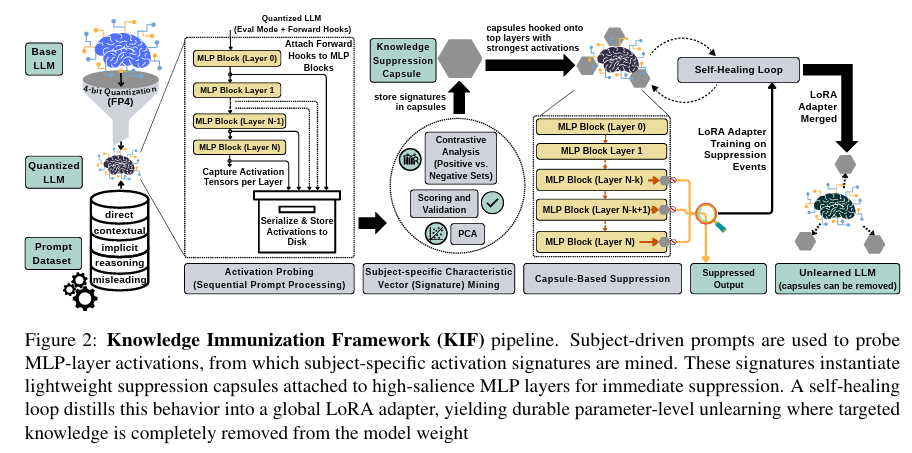 Representation-Aware Unlearning via Activation Signatures: From Suppression to Knowledge-Signature ErasureSelective knowledge erasure from LLMs is critical for GDPR compliance and model safety, yet current unlearning methods conflate behavioral suppression with true knowledge removal, allowing latent capabilities to persist beneath surface-level refusals. In this work, we address this challenge by introducing Knowledge Immunization Framework (KIF), a representation-aware architecture that distinguishes genuine erasure from obfuscation by targeting internal activation signatures rather than surface outputs. Our approach combines dynamic suppression of subject-specific representations with parameter-efficient adaptation, enabling durable unlearning without full model retraining. KIF achieves near-oracle erasure (FQ approx 0.99 vs. 1.00) while preserving utility at oracle levels (MU = 0.62), effectively breaking the stability-erasure tradeoff that has constrained all prior work. We evaluate both standard foundation models (Llama and Mistral) and reasoning-prior models (Qwen and DeepSeek) across 3B to 14B parameters. Our observation shows that standard models exhibit scale-independent true erasure (<3% utility drift), while reasoning-prior models reveal fundamental architectural divergence. Our comprehensive dual-metric evaluation protocol, combining surface-level leakage with latent trace persistence, operationalizes the obfuscation - erasure distinction and enables the first systematic diagnosis of mechanism-level forgetting behavior across model families and scales.
 -
 RECAST: Reparameterized, Compact weight Adaptation for Sequential TasksIncremental learning aims to adapt to new sets of categories over time with minimal computational overhead. Prior work often addresses this task by training efficient task-specific adaptors that modify frozen layer weights or features to capture relevant information without affecting predictions on previously learned categories. While these adaptors are generally more efficient than finetuning the entire network, they still require tens to hundreds of thousands of task-specific trainable parameters even for relatively small networks, making it challenging to operate on resource-constrained environments with high communication costs like edge devices or mobile phones. Thus, we propose Reparameterized, Compact weight Adaptation for Sequential Tasks (RECAST), a novel method that dramatically reduces task-specific trainable parameters to fewer than 50 - several orders of magnitude less than competing methods like LoRA. RECAST accomplishes this efficiency by learning to decompose layer weights into a soft parameter-sharing framework consisting of shared weight templates and very few module-specific scaling factors or coefficients. This soft parameter-sharing framework allows for effective task-wise reparameterization by tuning only these coefficients while keeping templates frozen.A key innovation of RECAST is the novel weight reconstruction pipeline called Neural Mimicry, which eliminates the need for pretraining from scratch. This allows for high-fidelity emulation of existing pretrained weights within our framework and provides quick adaptability to any model scale and architecture
 -
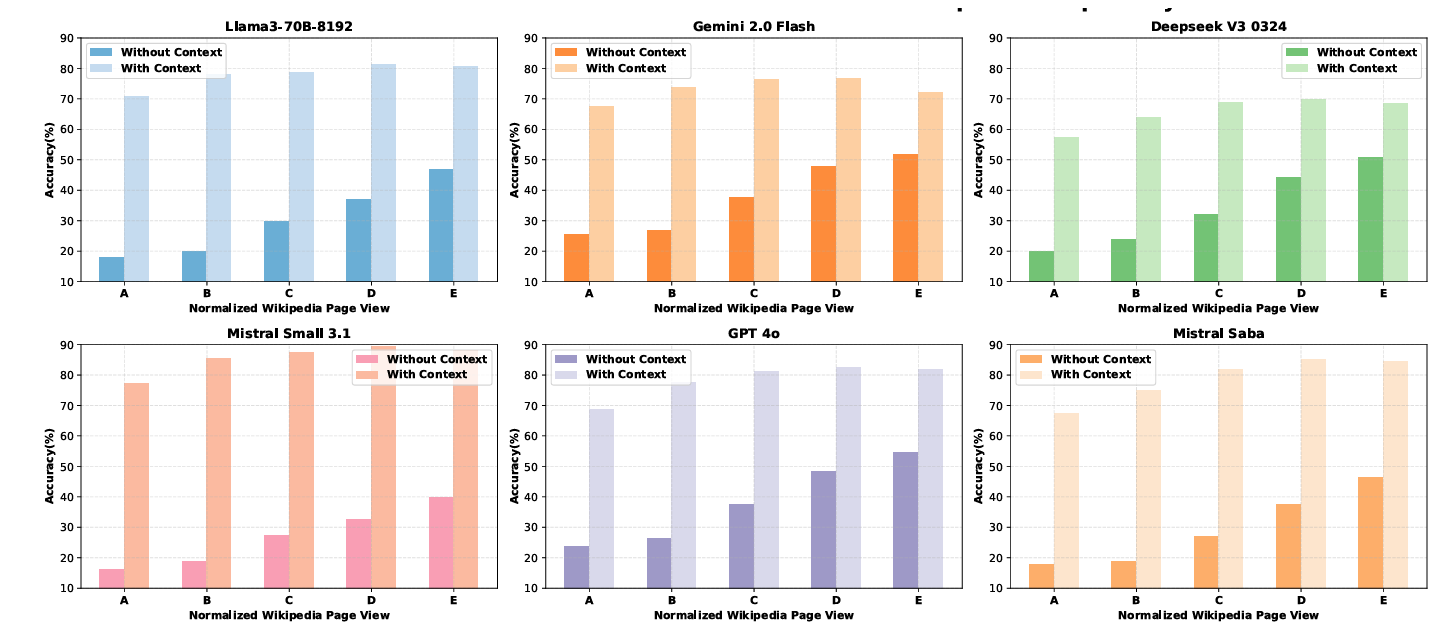 From Facts to Folklore: Evaluating Large Language Models on Bengali Cultural KnowledgeRecent progress in NLP research has demonstrated remarkable capabilities of large language models (LLMs) across a wide range of tasks. While recent multilingual benchmarks have advanced cultural evaluation for LLMs, critical gaps remain in capturing the nuances of low-resource cultures. Our work addresses these limitations through a Bengali Language Cultural Knowledge (BLanCK) dataset including folk traditions, culinary arts, and regional dialects. Our investigation of several multilingual language models shows that while these models perform well in non-cultural categories, they struggle significantly with cultural knowledge and performance improves substantially across all models when context is provided, emphasizing context-aware architectures and culturally curated training data.
 -
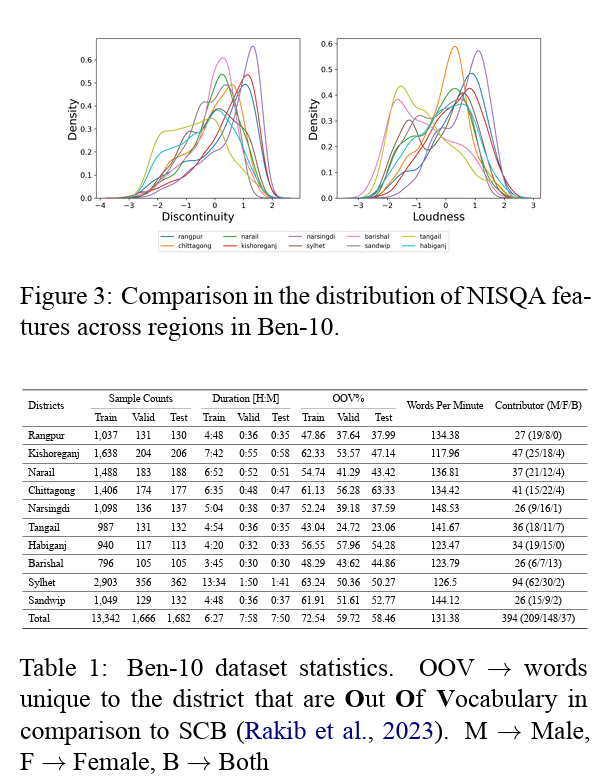 Are ASR foundation models generalized enough to capture features of regional dialects for low-resource languages?Conventional research on speech recognition modeling relies on the canonical form for most low-resource languages while automatic speech recognition (ASR) for regional dialects is treated as a fine-tuning task. To investigate the effects of dialectal variations on ASR we develop a 78-hour annotated Bengali Speech-to-Text (STT) corpus named Ben-10. Investigation from linguistic and data-driven perspectives shows that speech foundation models struggle heavily in regional dialect ASR, both in zero-shot and fine-tuned settings. We observe that all deep learning methods struggle to model speech data under dialectal variations, but dialect specific model training alleviates the issue. Our dataset also serves as a out-of-distribution (OOD) resource for ASR modeling under constrained resources in ASR algorithms. The dataset and code developed for this project are publicly available.
 -
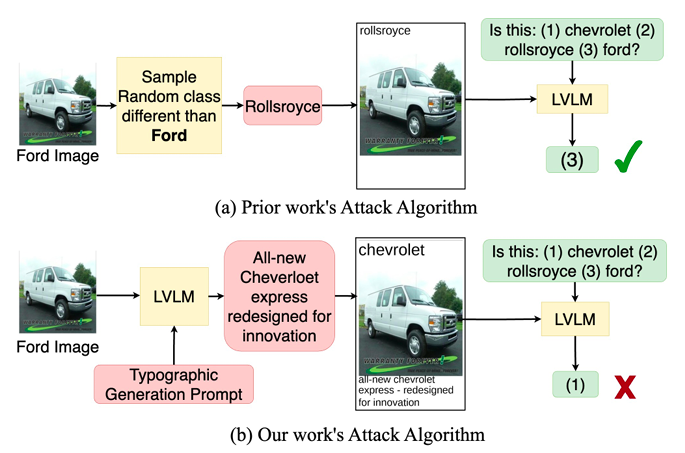 Vision-LLMs Can Fool Themselves with Self-Generated Typographic AttacksTypographic attacks, adding misleading text to images, can deceive vision-language models (LVLMs). The susceptibility of recent large LVLMs like GPT4-V to such attacks is understudied, raising concerns about amplified misinformation in personal assistant applications. Previous attacks use simple strategies, such as random misleading words, which don’t fully exploit LVLMs’ language reasoning abilities. We introduce an experimental setup for testing typographic attacks on LVLMs and propose two novel self-generated attacks: (1) Class-based attacks, where the model identifies a similar class to deceive itself, and (2) Reasoned attacks, where an advanced LVLM suggests an attack combining a deceiving class and description. Our experiments show these attacks significantly reduce classification performance by up to 60% and are effective across different models, including InstructBLIP and MiniGPT4. Code: https://github.com/mqraitem/Self-Gen-Typo-Attack
 -
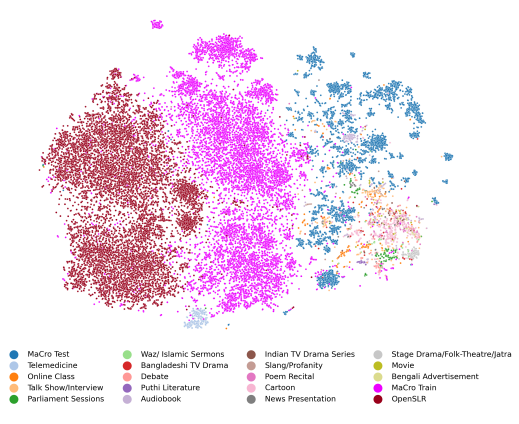 OOD-Speech: A Large Bengali Speech Recognition Dataset for Out-of-Distribution BenchmarkingWe present OOD-Speech, the first out-of-distribution (OOD) benchmarking dataset for Bengali automatic speech recognition (ASR). Being one of the most spoken languages globally, Bengali portrays large diversity in dialects and prosodic features, which demands ASR frameworks to be robust towards distribution shifts. For example, islamic religious sermons in Bengali are delivered with a tonality that is significantly different from regular speech. Our training dataset is collected via massively online crowdsourcing campaigns which resulted in 1177.94 hours collected and curated from native Bengali speakers from South Asia. Our test dataset comprises 23.03 hours of speech collected and manually annotated from 17 different sources, e.g., Bengali TV drama, Audiobook, Talk show, Online class, and Islamic sermons to name a few. OOD-Speech is jointly the largest publicly available speech dataset, as well as the first out-of-distribution ASR benchmarking dataset for Bengali.